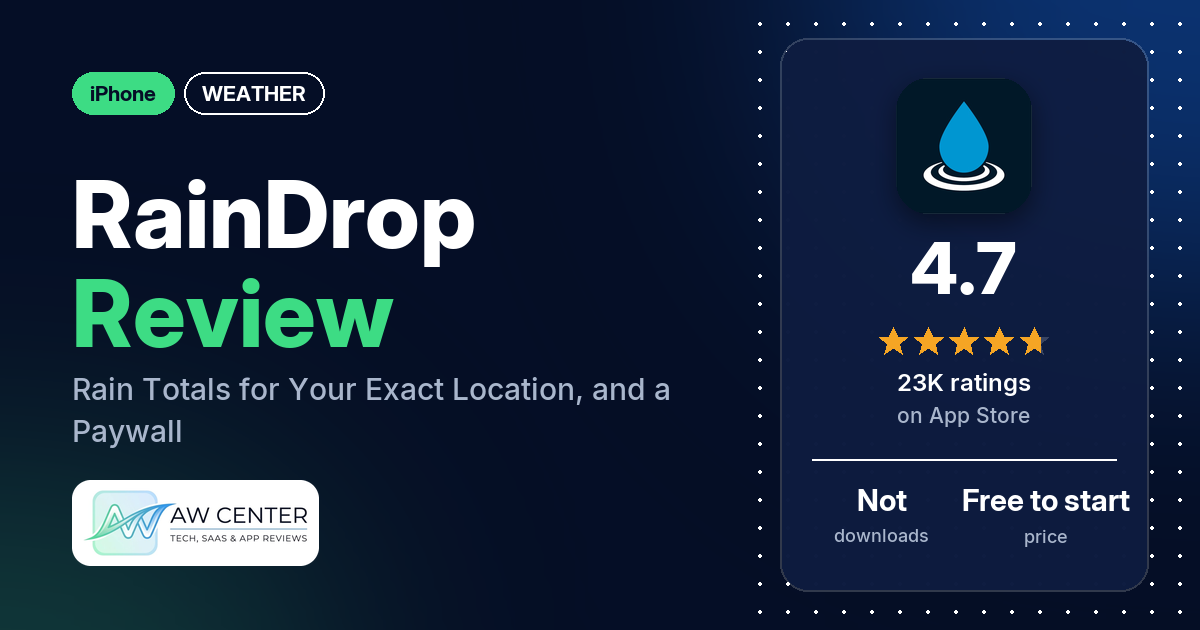
RainDrop – Rain Totals & Radar is an iPhone app from Raindrop Limited Liability Company that shows how much rain or snow fell at your exact location in the United States, with forecasts, a radar map and rain alerts. It’s free with your current GPS location, and the paid upgrade adds more saved locations, extended history, 16-day forecasts and rain alerts. That paywall is the most common complaint in recent reviews.
Quick verdict
If you farm, garden or manage outdoor work and want a rain total for a spot without a rain gauge, RainDrop is built for that, and the listing names farmers, contractors, landscapers and gardeners as its audience. Several reviewers call its totals accurate. Several others compared it with their own rain gauges and say it showed noticeably less rain. The biggest complaint is money: reviewers from March to May 2026 say features that used to be free, like the rain calendar and free locations, moved behind a subscription. A few reviewers in April 2026 say the app crashed, wouldn’t stay open or couldn’t be used after an update. The newest review in our data is from June 2026, and the app has been updated since, so check the listing before you pay. Don’t rely on a single app for severe weather warnings; check official alerts too.
RainDrop at a glance
| Developer | Raindrop Limited Liability Company |
|---|---|
| Store listing | RainDrop – Rain Totals & Radar on the App Store |
| Price | Free to start; paid upgrade (prices not in our data) |
| Ads | Not stated in the listing |
| App Store rating | 4.7 stars from 22,705 ratings |
| Downloads | Not in our data |
| Version / last updated | 3.1.79 / November 7, 2026 |
| Requires | iOS 16.0 or later |
| First released | July 17, 2023 |
| Data checked | November 10, 2026 |
What is RainDrop?
RainDrop is built to tell you how much rain or snow fell where you are. The listing says it gives real-time precipitation totals at your exact coordinates for any spot in the United States, so you don’t need a rain gauge. It adds hourly and daily forecasts, an animated radar, rain alerts and tracking for dozens of locations. You can use it free with your current GPS location; the listing says the upgrade unlocks more saved locations, full precipitation analytics, extended history, 16-day forecasts, all map layers, custom timeframes, rain alerts and the interactive rain calendar.
Key features
- Rain and snow totals: real-time totals at your exact coordinates, with hour-by-hour, daily, monthly and yearly breakdowns, year-over-year comparisons, monthly rainfall trends and a custom date range.
- Rain calendar: an interactive calendar where you tap any day for hourly detail.
- Forecasts: 16-day daily and hourly forecasts with temperature, wind speed, humidity and pressure, plus severe weather alerts and warnings.
- Live weather map: an animated radar with rain and snow accumulation layers. You can tap anywhere on the map to see precipitation totals.
- Rain alerts: set a rainfall threshold for each saved location, get notified when precipitation passes it, and choose your alert time.
- Multiple locations: the listing says you can save and monitor dozens of locations, compare precipitation across them, and search for any US location.
- Sharing: share rainfall totals and map screenshots with your team, clients or neighbors.
- Support: the listing says you can chat with the developer inside the app.
RainDrop vs. what a weather app should have
RainDrop is built around rain totals, so its listing skips many general weather features. “Listed” means the App Store listing names a feature, “Partial” means it names part of it, and “Not listed” means it doesn’t mention it. The listing says several of the listed features need the paid upgrade.
Must have
| Feature | Status | Notes |
|---|---|---|
| Current conditions and feels-like | Not listed | Real-time precipitation totals are listed; current conditions and feels-like aren’t |
| Hourly forecast | Listed | |
| Daily forecast of 7+ days | Listed | 16-day forecasts, part of the paid upgrade |
| Chance of precipitation | Not listed | The listing says it shows how much it will rain; it doesn’t mention a percentage chance |
| Wind, humidity, UV index | Partial | Wind speed and humidity are listed; UV index isn’t |
| Severe weather alerts | Listed | |
| Radar map | Listed | Animated radar with rain and snow accumulation layers |
| Home-screen widgets | Not listed | |
| Current location and search | Listed | Current GPS location, and search for any US location |
| Unit options (°F/°C) | Not listed |
Should have
| Feature | Status | Notes |
|---|---|---|
| Notification or lock-screen weather | Not listed | |
| Air quality | Not listed | |
| Multiple saved locations | Listed | Dozens of locations with the upgrade; a few reviewers say free locations were cut |
| Choice of data source | Not listed | |
| Layout customization | Not listed | |
| Light and dark themes | Not listed | |
| Sunrise, sunset, moon phase | Not listed | |
| Multiple languages | Not listed |
Nice to have
| Feature | Status | Notes |
|---|---|---|
| Animated wind or global map | Not listed | The animated map is a rain and snow radar |
| Side-by-side provider comparison | Not listed | |
| Photography times (golden/blue hour) | Not listed | |
| Weather photos | Not listed | |
| Pollen | Not listed | |
| Lightning strike information | Not listed | |
| Custom temperature alerts | Not listed | Alerts are for rainfall thresholds |
| Rain-incoming notifications | Partial | Alerts fire when rainfall passes a threshold you set; the listing doesn’t mention alerts before rain starts |
| Written forecast summary | Not listed |
Rain totals get the deepest coverage here; forecasts cover the basics. Whatever weather app you use, don’t rely on one app alone for severe weather warnings. Check official alerts from your national weather service too.
Pros (from user reviews)
- Accurate for some: several reviewers call the totals accurate, including a farmer and agronomist who uses it every day. One of them, in March 2026, says it’s occasionally off a little. Several others say it showed less rain than their gauges; see Cons.
- Rain at more than one place: a few reviewers like monitoring rainfall at several locations. One in March 2026 says you can have “a rain gauge in each location” and know whether to send a crew to work. A few others say free locations were cut back.
- No gauge to empty: one reviewer in May 2026 who also keeps a traditional rain gauge says the app “does a great job” and they don’t have to empty it each day, and that it helped them save water.
- Up-to-date totals: one reviewer praises the “up to the minute updates,” and one calls it the most convenient way to know if you’re in a drought.
Cons (from user reviews)
- Paywall and a shrinking free version: the most common complaint, from March to June 2026. Several reviewers say features that used to be free now need a subscription. A few name the rain calendar, and a few say the free locations were cut; one in April 2026 says even a single free location is now locked. Several say they can’t use the app at all without paying, though the listing says you can use it free with your current GPS location. Two call the change a “bait and switch.”
- Totals below rain gauges: several reviewers from April to June 2026 compared RainDrop with their own gauges and say it showed less rain, such as 1.5 inches against 3.5 (May 2026) and 1.92 against 3.1 (April 2026). One says it showed 0 inches for 72 hours when it had rained several times, and one says it showed a negative total on a day it rained all day. Two say a total was revised down after the storm.
- Price: a few reviewers call the subscription too expensive for what it offers, and two say free apps give them almost the same data. See Pricing for the prices reviewers quote.
- Billing problems: two reviewers report trouble. One in June 2026 subscribed, was still asked to subscribe, and says customer service didn’t help. One in May 2026 expected to pay monthly and was charged $32 for the entire year.
- Crashes after an update: a few reviewers in April 2026 say that after an update the app crashed, wouldn’t stay open, or couldn’t be used.
- Removed views: a few reviewers say updates removed views they relied on, such as weekly rain totals (two reviewers, who used them to decide when to water) and five years of free records. One of them notes the update added dew point, humidity and a barometer.
- Location: one reviewer says the app doesn’t show their location correctly, and one says it only offers a community 10 to 15 miles from their home.
Most reviews in our sample are 1 or 2 stars, while the App Store rating is 4.7 from 22,705 ratings. The data we collected doesn’t include a star breakdown, so we can’t say how common these complaints are across all ratings.
Pricing
RainDrop is free to download, and the listing says you can use it free with your current GPS location. The upgrade adds more saved locations, full precipitation analytics, extended history, 16-day forecasts, all map layers, custom timeframes, rain alerts and the interactive rain calendar. The listing doesn’t give prices, and our data doesn’t include in-app purchase prices. Reviewers in May and June 2026 mention $29 a year, $32 for the year, $50, and “a minimum of $49 per year.” They disagree on a monthly plan: one in May 2026 says there is no 1-month subscription, while one in April 2026 says they should have picked the monthly to test it first. Prices change, so check the App Store before you subscribe.
Privacy and permissions
We couldn’t read the App Store privacy label for RainDrop, and our data doesn’t include a permissions list, so we make no claim about what data it collects. The listing says the free version works with your current GPS location and links to a privacy policy at raindrop.farm/privacy-policy. One reviewer says the app doesn’t show their location correctly.
Who it’s for
RainDrop fits you if you need rain totals for fields, job sites or a garden in the United States and are willing to pay for saved locations, history and alerts. The listing names farmers, contractors, landscapers and gardeners. It’s a weaker fit if you want a free app with history or more than your current location, since several reviewers say the free version shrank in 2026. If you need gauge-level precision for decisions, keep your own rain gauge to compare, because several reviewers report totals well below theirs. The listing describes US locations and doesn’t mention other countries.
FAQ
Is RainDrop free?
The listing says you can use RainDrop free with your current GPS location. More saved locations, extended history, 16-day forecasts, rain alerts and the rain calendar need the upgrade. Several reviewers in 2026 say features that used to be free now need a subscription, and several say they couldn’t use the app at all without paying.
How accurate are RainDrop’s rain totals?
Reviewers disagree. Several call the totals accurate, including a farmer and agronomist. Several others compared the app with their own rain gauges from April to June 2026 and say it showed less rain, sometimes by more than an inch.
Does RainDrop work outside the United States?
The listing describes precipitation totals for any spot in the United States and search for any US location. It doesn’t mention other countries.
Can RainDrop alert me when it rains?
Yes, with the upgrade. The listing says you can set a rainfall threshold for each saved location, get notified when precipitation passes it, and choose your alert time. It also lists severe weather alerts and warnings.
How this review was put together
We haven’t tested RainDrop. This review is based on public information from official sources: the app’s Google Play or App Store listing and rating breakdown, the developer’s website when there is one, and recent user reviews on the store with the developer’s replies. Features and claims are the developer’s own descriptions; what users like and dislike comes from the store reviews. Everything was checked on November 10, 2026. Apps change with every update, so check the store listing before you install.